


Robots are one of the most active areas of technology right now. They combine software, hardware, and AI, and are increasingly being deployed at scale. To see what is possible today, I visited the Canton Fair in China to understand what robot hardware is available to buy in volume this year and at what prices. I also wanted to assess the depth of the supply chain, the degree of commoditisation, how advanced the software is, and what to expect in the coming years.
The Fair
The Canton Fair is a large biannual exhibition in Guangzhou showcasing everything being built in China. It is a place to see the latest manufacturing output, where distributors and manufacturers come to source components or entire white-labelled products for resale. It is held in a massive 500,000 m² exhibition complex. The event is so large that it is split into three phases. Phase 1 focuses on consumer electronics, home appliances, and industrial machinery—that’s where the robots are.


The most advanced robots are housed in “Friendship Hall.” Presumably this refers to the idea of friendship between humans and robots. The hall features large cyborg whale graphics moving around. Unlike other exhibits, it requires an additional layer of biometric security to enter.
The space is packed with robots—of all sizes and for a wide range of use cases. Delivery, patrol, inspection, firefighting, house cleaning, logistics. Robots with arms, wheels, or legs, and some with both legs and wheels. Even a massage robot.


Unlike more specialised conferences like WRC, the Canton Fair focuses on robots that can already be purchased in bulk for specific real-world use cases, rather than research prototypes.
Quadruped robots
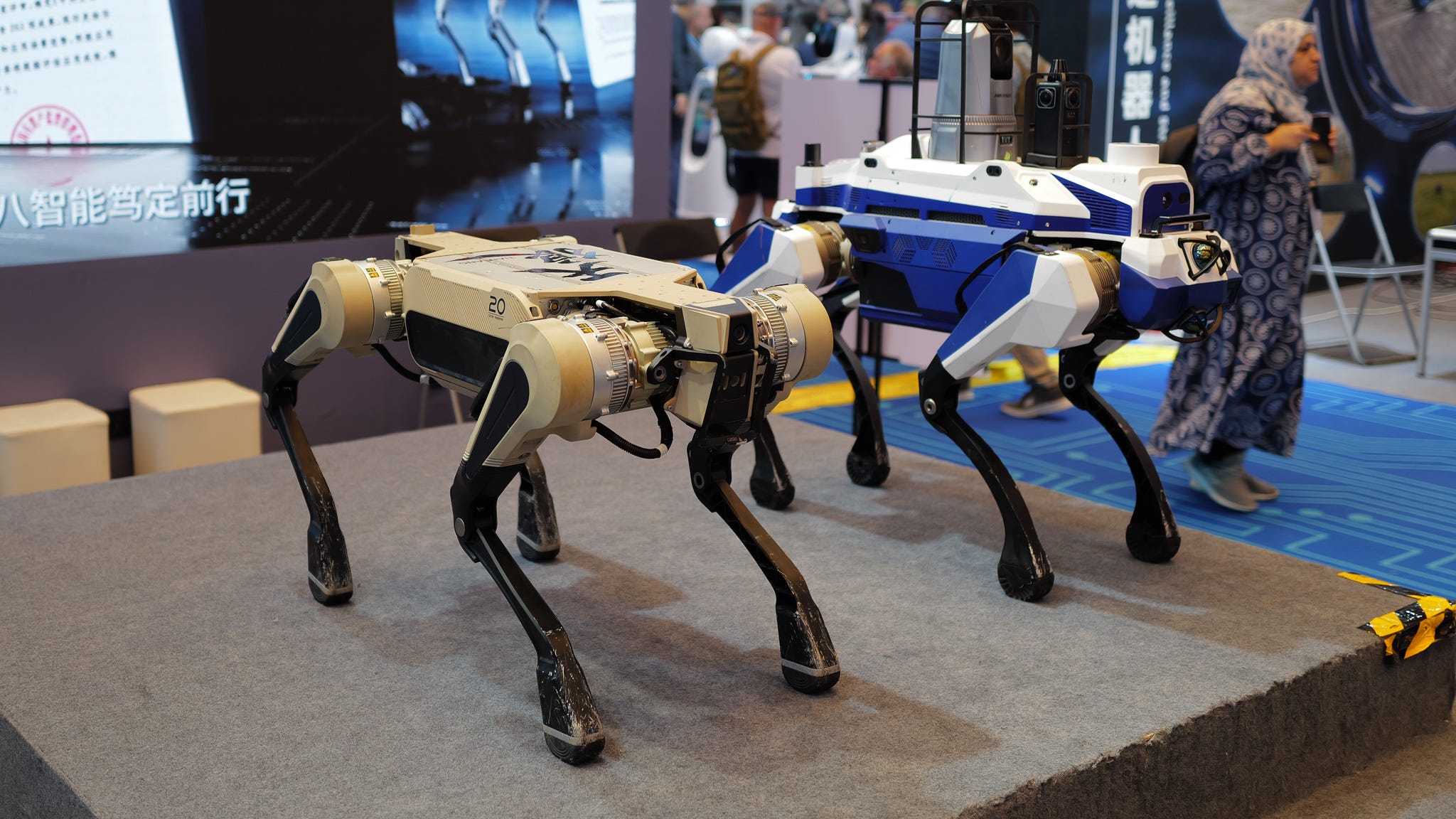
This is the most common category at the fair. You may have seen videos of Boston Dynamics’ Spot or China’s Unitree Go. Unitree is not the only robotics company in China—there are dozens of similar companies. The supply chain for quadruped robots is well developed and becoming commoditised. You can buy both basic chassis that provide locomotion, as well as vertically integrated robots with payloads for specific use cases. These can include multi-modal sensors, robotic manipulators, net guns for catching intruders, or fire extinguishers.


Pricing is typically negotiated and depends on order size, as well as whether you are buying just the chassis or a fully integrated robot with payload. The ballpark quoted prices are:
Humanoid robots
Humanoid robots are also present, but less abundant. This is still frontier robotics. You can buy pairs of robotic hands, humanoids on wheeled platforms, or fully fledged robots with legs. Prices are generally higher.


Security robots
One of the main applications for robots on display is inspection and security. About half of the robots are configured and marketed for this use case.
This starts with simple patrol robots equipped with more advanced cameras, often including infrared. These are available in both wheeled form (for flat surfaces) and quadruped form factors (able to climb stairs). Indoor wheeled patrol robots cost around $8k, larger outdoor versions about $30k, and mid-sized quadruped patrol robots about $60k.


This progresses to robots that can act, such as quadruped robots equipped with net guns for catching intruders and tear gas canisters.


If that is not enough as a deterrent, there is also a massive 200 kg rotunbot that can collide with objects at a speed and force comparable to a motorcycle. It is marketed at around $110k per unit.


Robot parts & software
If you don’t want to buy a ready-to-go wholesale robot, you can build your own. Building robots involves components that are distinct from typical electronics: robot motors, end manipulators (i.e. robot hands), robot software, and data collection devices for machine learning.
There are electric motors specifically designed for different robot joints—legs, arms, or smaller ones for fingers. These are typically high-torque, low gear ratio motors. There are also specialised design firms that can help design and manufacture motors to specific requirements.


Basic robot grippers are cheap and widely available. More delicate humanoid hands are still niche and expensive. A low-end 6 degrees of freedom (DoF) hand can cost around $3k, increasing to about $30k for an 11 DoF hand and up to $60k for a 20 DoF hand with built-in pressure and temperature sensors.


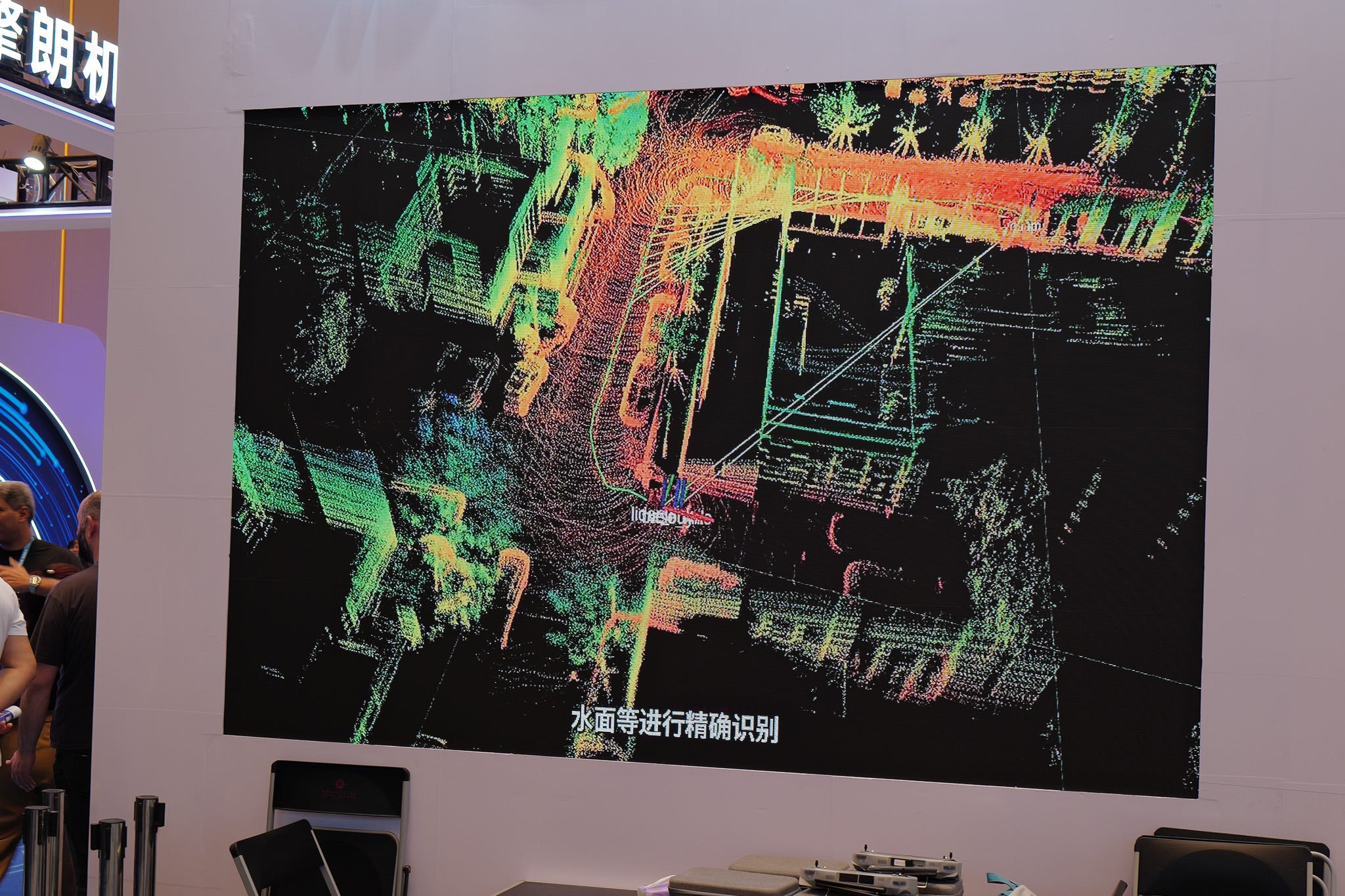
The leg locomotion software driving most quadruped robots is widely available. Most of the displayed robots can move around and climb stairs relatively smoothly. When operating autonomously rather than being remotely controlled—such as in security patrol or delivery use cases—navigation is typically handled through map-based systems using lidar sensors, SLAM (simultaneous localisation and mapping), and basic obstacle avoidance.
This changes when it comes to advanced manipulation tasks for humanoid robots. This remains frontier robotics, which is why few humanoid robots are actually performing complex tasks. Developing these capabilities involves multi-modal machine learning and requires specialised datasets of humans performing various actions. For around $8k, you can now buy kits to capture this data, which can also be used for remote teleoperation.


Judging the progress
The Chinese manufacturing industry is highly competitive and able to fast-follow trends, which is now reflected in robotics hardware. If you have an application that requires a specific hardware platform at scale, you can either buy it or design it end-to-end in China.
Software capabilities for many applications, such as security patrols or deliveries, are also already largely available. China is quick to productionise these use cases, and you can see delivery robots in hotels and self-driving taxis on the streets in Shenzhen.
Other applications, particularly those requiring precise human-like manipulation, still need advances in foundational machine learning for robotics. You won’t yet find companies capable of performing complex autonomous tasks similar to those demonstrated by Physical Intelligence. At the same time, companies like Unitree have been closing the gap in whole-body locomotion for humanoid robots quite rapidly. Once the approach to manipulation is solved, it would not be surprising to see the Chinese industrial base fast-follow in that area as well.